Siding Replacement in Nashville & Middle Tennessee
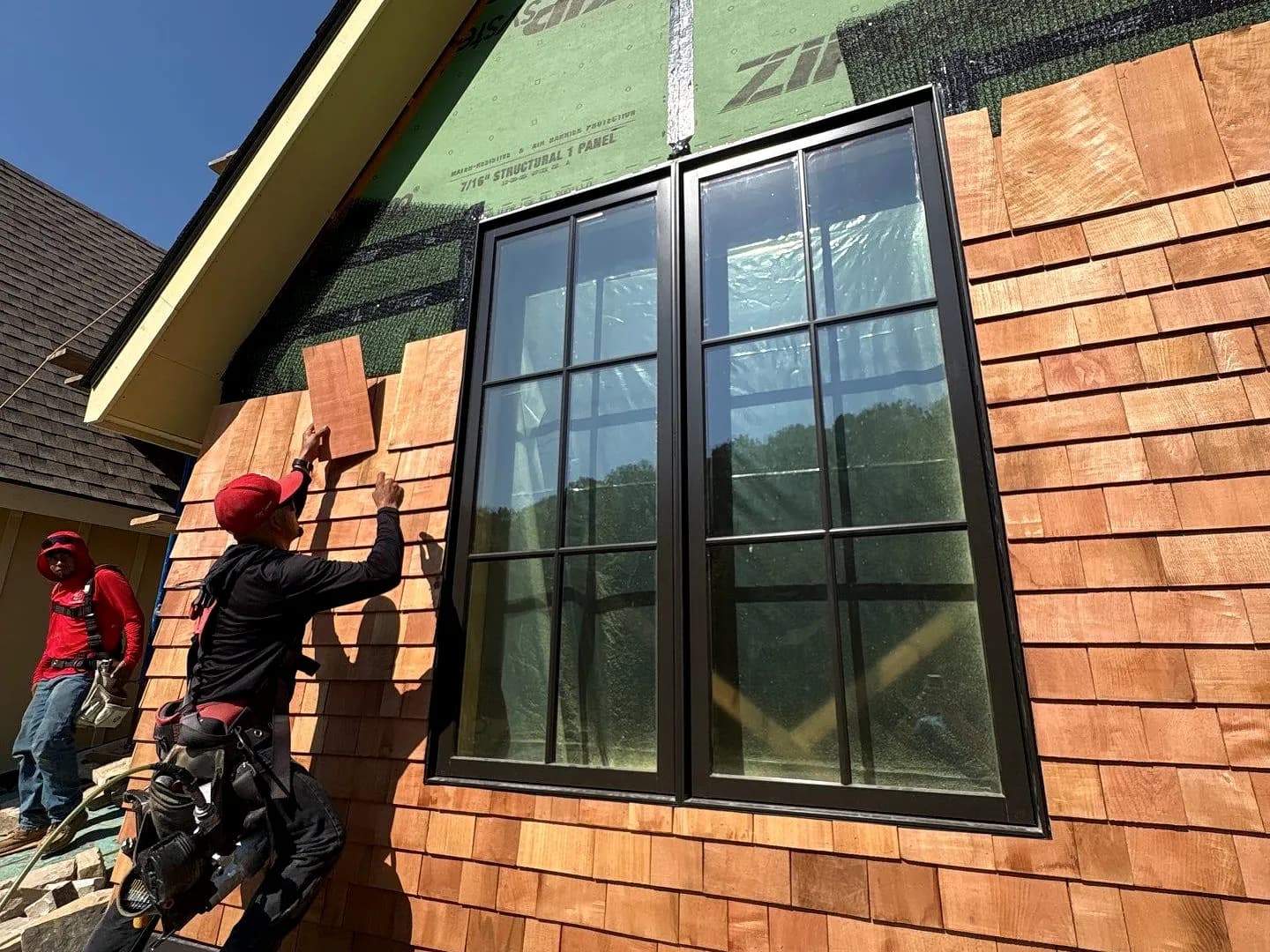
A wall gets wet. Every wall does — wind-driven rain finds its way past a joint eventually, and the siding was never the thing keeping it out. What decides whether that wall dries or rots is what sits behind the cladding: the water barrier, the flashing at every opening, and whether there is anywhere for water to go.
The inspection is free, with a plain answer about what the roof needs.
Read our Google reviewsGAF Certified · ID 1160390
- Materials
- Fiber cement, cedar, engineered wood, board and batten
- Behind it
- Water barrier, flashed openings, a drainage gap
- Fasteners
- Corrosion-resistant; spacing set by wind load, not habit
- Service life
- 30–50 years for the fiber-cement class
Choose siding when
- The siding and the roof are the same age. Doing both at once means one crew, one set of flashings detailed together, and no second disruption in three years.
- There is soft wood at the bottom course, under a window, or where a roof meets a wall. That is water that got in and could not get out, and new cladding over it buys nothing.
- You are changing how the house reads from the road. Siding is the largest surface on the elevation and the cheapest way to change it.
- New construction, where the wall assembly is still a decision rather than a discovery.
When it is the wrong answer
- One elevation took a one-off hit — a tree, a vehicle, a hail line on the north face. That is a repair, and a repair is what we will quote.
- The paint is tired and the substrate is sound. Paint is a fraction of the cost and will carry a good wall for years.
Installing siding, step by step.
- 01
What is behind it decides the job
The cladding comes off and the wall is read before anything is ordered: the water-resistive barrier, the flashing at every window and door, the kick-out where a roof dies into a wall. Most of what fails a wall is one of those three, and none is visible until the siding is off.
- 02
The openings, not the field
A field of siding rarely leaks. Windows, doors, penetrations and roof-to-wall junctions do, and they leak at the detail rather than at the product. That detailing is the part of the day that decides the next twenty years.
- 03
Fastening is a specification
Fastener type, penetration and spacing come from the product's instructions and the wind load for the site — corrosion-resistant, placed to the manufacturer's pattern, not to the crew's habit. It is also the part an inspector can check after the fact.
What people ask us first.
- Fiber cement, vinyl or cedar?
- Fiber cement is the default in this market: it holds paint, it does not feed insects, and it behaves in a Tennessee summer. Cedar is for a house whose architecture asks for it and an owner who accepts maintenance. Vinyl is the cheapest and the one that shows its price from ten feet away.
- Does the siding need a gap behind it?
- A drainage gap — a rainscreen — lets a wall that got wet dry out, and it is a best practice for fiber cement rather than a code minimum everywhere. Whether your wall needs one depends on exposure, the assembly and the product's own instructions, which is a conversation before the order rather than a rule we apply to every house.
- Can you do the siding and the roof at the same time?
- Yes, and it is usually the right order to do them in. The roof-to-wall flashing belongs to both trades; when they are two visits by two companies, that junction is where the finger-pointing starts.
- What happens to the trim?
- It gets priced as part of the job rather than discovered halfway through. Corners, bands, window and door surrounds and the soffit are where the labour hides, and a quote that only counts square feet of field is a quote that will change.
Talk to us about siding.
A leak, a missing shingle, a roof that has simply reached the end of its life — describe it and we will come look. The inspection is free. If it is urgent, calling is faster.
(615) 418-6087 · 8:00 AM – 6:00 PM
Request an inspection
Tell us what the roof is doing. If it is urgent, calling is faster.